
Your CLAUDE.md File Is Your Highest Point of Leverage
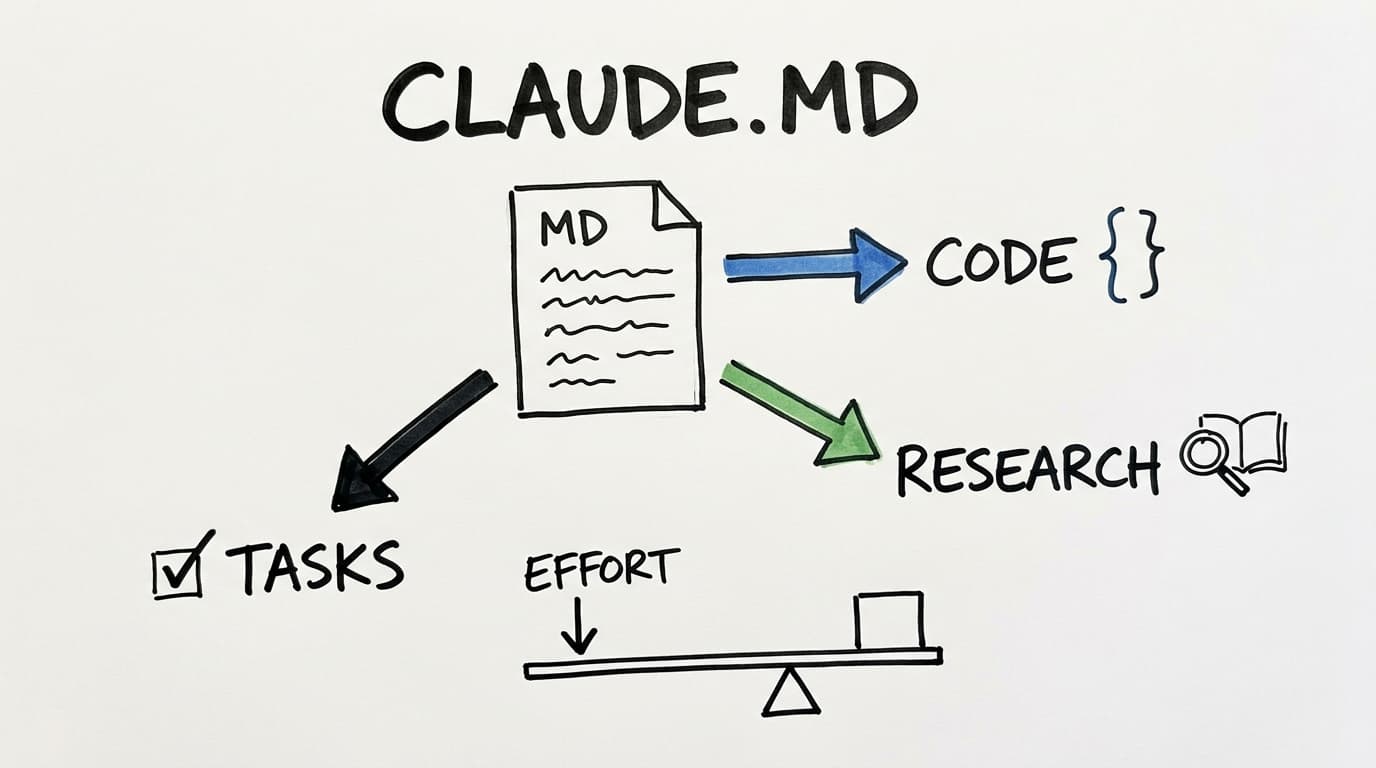
Most people obsess over which AI model to use. They benchmark Opus against Sonnet, debate temperature settings, fine-tune their API calls. Meanwhile, the single most impactful thing they could change is a markdown file sitting in the root of their project.
Here's the thing about CLAUDE.md: one bad line doesn't just produce one bad outcome. It cascades. A poorly worded instruction leads to bad research, which leads to a bad plan, which generates hundreds of lines of broken code. The leverage works in both directions. Get it right and the model becomes eerily competent. Get it wrong and you'll spend your afternoon debugging problems you accidentally created.
I know this because I've been living it.
I Have a 200+ Line CLAUDE.md. And That Might Be Too Many.
My "Artificial Brain" project runs almost entirely through Claude Code. Daily planning, habit tracking, task management, session logging, weekly reviews. The CLAUDE.md file describes the whole system: folder structures, behavior modes, accountability rules, habit philosophy. Add in the command files and skill definitions that Claude lazy-loads, and we're talking thousands of lines of instructions across the project.
It works remarkably well. Most of the time.
But I've also watched it break in subtle ways. Claude starts ignoring a scheduling convention. It forgets the tone I specified for habit check-ins. It merges two workflows that should stay separate. And every time I trace the issue back, I find the same root cause: too many instructions competing for attention.
There Is an Instruction Budget and You're Probably Over It
This is the part nobody talks about. Models don't just absorb unlimited context and treat every instruction equally. Research suggests accuracy starts degrading after roughly 150-250 instructions. The Claude Code system prompt already uses around 50 of those. That leaves you about 200 instructions before the model starts dropping things.
Think about that. 200 instructions. An analysis of over 1,000 public CLAUDE.md files found that roughly 10% were over 500 lines. Those projects aren't getting better results with more instructions. They're getting worse.
The instinct is always to add. The model did something wrong, so you add a rule. It ignored a convention, so you add a reminder. It used the wrong tone, so you add a paragraph about voice. Each addition feels justified in isolation. But collectively, you're burying the important stuff under a pile of increasingly contradictory noise.
Remove Rather Than Add
The counterintuitive move is deletion.
Vercel had a great example with their D0 agent. They went from 80% to 100% accuracy not by adding more constraints, but by removing tools and instructions. The agent got better when they stopped over-specifying.
This tracks with how models improve over time. Best practices get baked into the weights. Things you needed to specify six months ago are now default behavior. That instruction telling Claude to "write clean, readable code" or "use descriptive variable names"? It already does that. You're wasting budget on instructions the model would follow anyway.
I've started noticing this in my own setup. Instructions I added months ago about formatting conventions that Claude now handles natively. Rules about file naming that were relevant with earlier models but are now redundant. Every line I remove is a line of budget I get back for the instructions that actually matter.
Start Small, Add Only When It Breaks
The best approach is the opposite of what most people do. Instead of starting with a massive prompt template you found on Twitter, start with almost nothing. Project description. Key commands. Maybe a paragraph about the tech stack.
Then use it. When the model makes a mistake, add one specific instruction to address it. This way you can actually trace which addition caused which behavior change. You build a CLAUDE.md that's earned every line, not one bloated with speculative rules.
This is the "random prompts from Twitter" problem. Someone shares their CLAUDE.md and it goes viral. Thousands of developers copy-paste it into their projects without understanding why any specific line exists. Now they have 300 lines of instructions, half of which contradict each other, written for a completely different project and workflow.
Your CLAUDE.md should be as unique as your codebase. Nobody else's will work for you.
Structure Beats Volume
One thing that has worked well for me: splitting instructions across nested CLAUDE.md files in subdirectories. The root file stays lean with the project overview and critical conventions. Subdirectory files hold context-specific instructions that only get loaded when Claude is actually working in that part of the codebase.
Claude Code lazy-loads these. When it reads a file in a subdirectory, the local CLAUDE.md gets appended to the tool results. Your root file isn't carrying the weight of every edge case for every corner of the project.
Positioning matters too. LLMs weigh instructions at the beginning and end of context more heavily than the middle. Put your project description and key commands near the top. Put critical rules at the end. Don't bury important things in paragraph 47 of a wall of text.
When Instructions Aren't Enough, Use Hooks
For truly critical rules, instructions aren't reliable enough. If your CLAUDE.md says "never run database push in production," the model will follow that instruction 29 out of 30 times. Maybe 49 out of 50. That sounds good until you realize the one time it doesn't is the time that matters.
Hooks enforce rules at the system level. They run before or after specific actions and can block dangerous operations entirely. No instruction-following variance. No "the model was juggling too many rules and this one slipped." Just a hard gate.
The distinction is simple: use CLAUDE.md for preferences and conventions. Use hooks for anything where a single failure would cause real damage.
Audit Regularly
Here's what I'm committing to after sitting with these ideas: a regular audit of my CLAUDE.md setup. After every major model upgrade, go through and ask: does this instruction still need to exist? Is the model handling this natively now? Am I specifying behavior that's already default?
It's a maintenance task, like cleaning up dead code. Nobody wants to do it, but the project gets measurably better every time you do.
The paradox of CLAUDE.md is that the people who spend the most time on it often get the worst results. Not because they don't care, but because they care too much in the wrong direction. They keep adding when they should be subtracting.
Your CLAUDE.md file is the highest leverage point in your entire AI workflow. Treat it like it. Every line should earn its place, and most of the lines you're tempted to add probably shouldn't be there.