
The Skill Is Knowing When to Stop
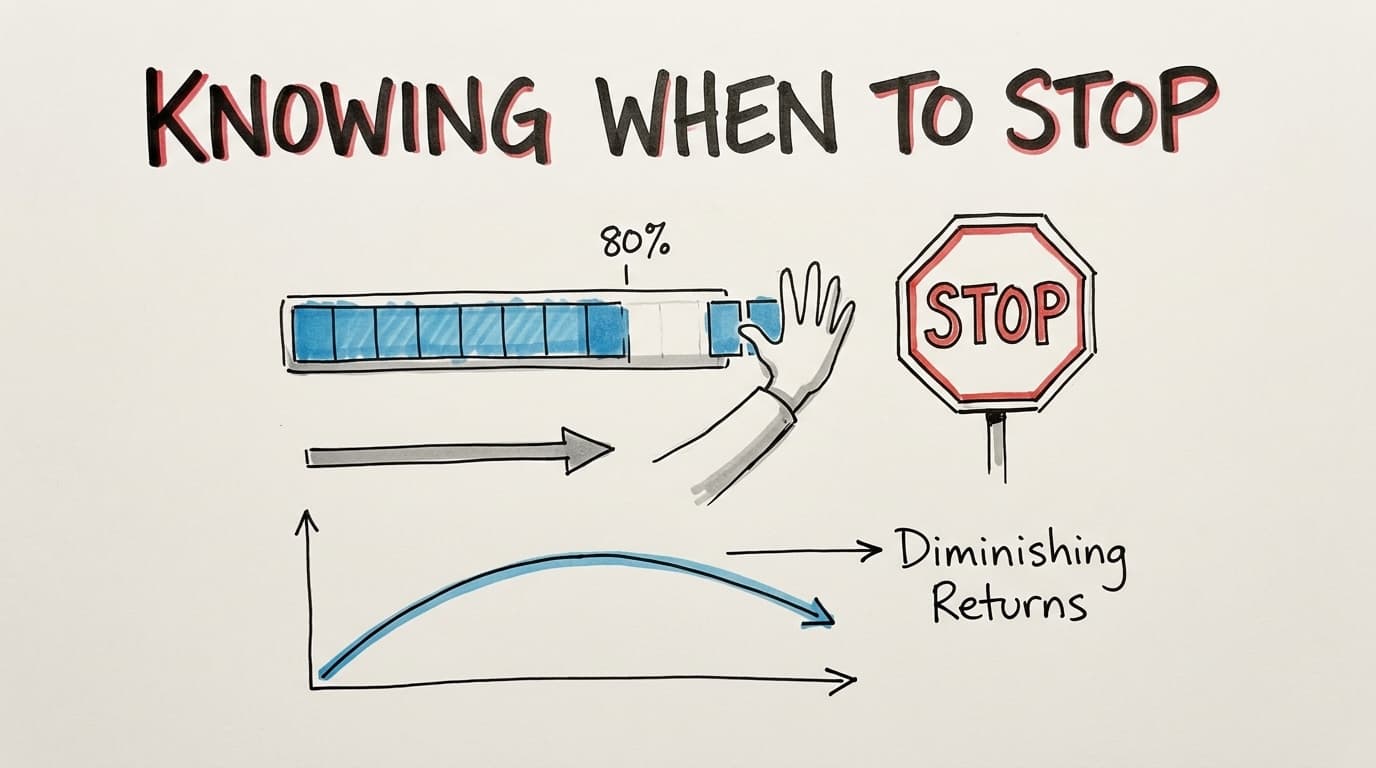
I used to tell my junior designers and developers: there's always a moment in a task — especially design — where more time and effort has zero effect on the end benefit to the user. Sometimes it even makes things worse. Overdesigned. Overthought. Lost clarity.
The skill was recognising that moment. And it was hard to teach because it's not a rule — it's a feeling. You had to have been burned by over-iteration enough times to develop the instinct.
AI just broke that instinct for most people.
The Study
HBR published research from Berkeley tracking 40 workers at a 200-person tech company over 8 months. The finding was counterintuitive: people who used AI didn't work less. They worked more. They took on broader scope, extended into more hours, explored more options — without being asked to.
AI made "doing more" feel possible, so they just... did more. Not better. More.
The researchers described it as AI intensifying work rather than reducing it. The efficiency gains didn't translate into free time. They translated into expanded ambition. People filled every minute the AI saved with more tasks, more iterations, more scope.
The Sweet Spot of Effort
In design, there's a point where iteration hurts the output. I've seen this dozens of times. Version 4 of a wireframe is tighter than version 1. Version 8 is usually worse than version 4 — overcooked, hedged, trying to please everyone.
In research, there's a similar sweet spot. Enough to understand the problem. Not so much you drown in options and second-guess everything. I've watched teams commission three rounds of user research that told them the same thing the first round did, because the tool made it easy to keep going.
In writing, it's the same. My first draft is usually rough. My second draft is better. My fourth draft is sometimes worse than my second because I've started over-editing, smoothing out the edges that made it interesting.
AI removes the friction of doing more. But friction was actually useful. It forced you to be intentional about where you spent effort. When every iteration is cheap, you lose the forcing function that made you decide: is this good enough?
The Real Question
The skill isn't using AI. The skill is knowing when to stop using it.
This is harder than it sounds. AI tools are optimised to encourage continued interaction. Every autocomplete suggestion invites another edit. Every "want me to try a different approach?" is a prompt to keep going. The tool has no concept of enough.
Neither do most professionals, apparently. The HBR study showed that even experienced workers — people who should know when a task is done — expanded their scope when AI made expansion easy. The constraint wasn't capability. It was judgment.
What I Do Differently Now
I've started setting explicit stopping points before I start a task. Not time limits — output limits. "I need a first draft of this blog post. I will write it once, review it once, and publish." Not "I will iterate until it's perfect."
With my Artificial Brain system, I've built this into the workflow. When I run the morning routine, Claude presents three priorities for the day. Not five. Not "whatever feels important." Three. The constraint is the feature.
For design work, I tell Claude to generate one wireframe approach, not three. If the first approach is wrong, I'll know — and I'll course-correct. But I won't spend an hour comparing three AI-generated options that are 90% identical, looking for the 10% difference that doesn't actually matter.
Where I Land
AI is the most powerful productivity tool I've ever used. It's also the most effective procrastination tool I've ever encountered — because it disguises procrastination as productivity. "I'm iterating" feels like work. "I'm exploring options" feels like thoroughness. "I'm trying one more approach" feels like diligence.
Sometimes it is. Often it isn't.
The professionals who will thrive with AI aren't the ones who use it most. They're the ones who know when to use it, how much to use it, and — crucially — when the work is done.
The skill is knowing when to stop. AI can't teach you that. You have to learn it the old-fashioned way: by stopping too late enough times that you develop the instinct for stopping on time.