
The K-Shaped Trap: Why the Travel Industry's Bet on Luxury is a Losing Game
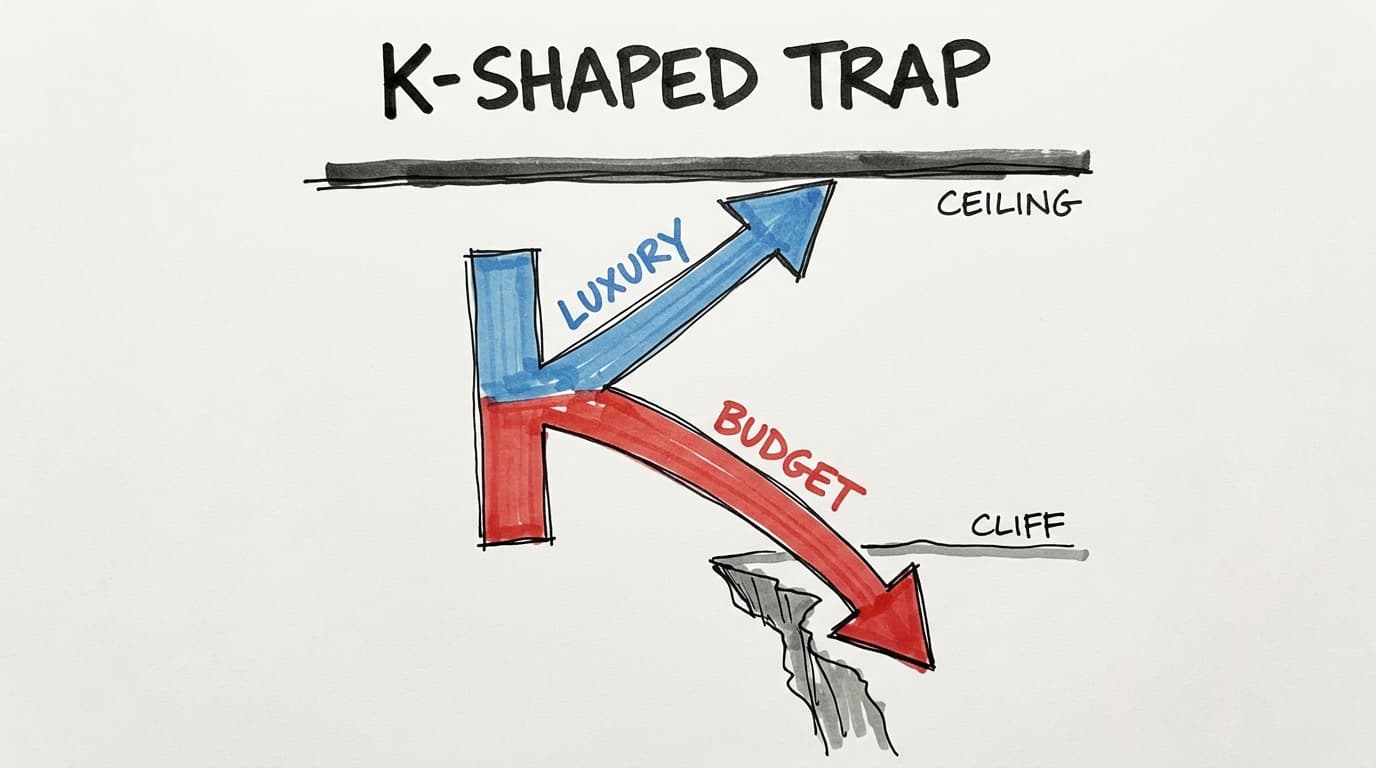
The travel industry loves the K-shaped economy narrative. It goes like this: sure, budget travellers are struggling, but luxury is booming — so pivot to premium and ride the wave. Delta's premium revenue is up 9% year-over-year. United is launching caviar in business class. Adventure travel is a $1.16 trillion market. The money is at the top.
But here's what nobody's saying: the top line has a problem too.
The Standard K-Shape Narrative
The post-pandemic recovery didn't lift all boats. It split them. The industry's playbook is clear: follow the money upward. Premium experiences, boutique hotels, curated itineraries. Revenue per guest is up even as total guest numbers flatten.
The conventional wisdom says this is sustainable — you don't need volume when you have value.
The conventional wisdom is wrong.
The Lower Line Cut-Off
There's a point on the lower line where people don't trade down — they exit.
Not "we'll go somewhere cheaper." Not "we'll do a staycation instead." Just: we don't travel. Full stop.
This isn't gradual belt-tightening. It's a cliff. When a family holiday costs 40% more than it did five years ago, millions of households don't adjust their plans — they cancel them entirely.
The German tour operator data from ITB Berlin already tells this story: revenue up 6%, but forward bookings down 5%. Fewer people are travelling. The ones who do, spend more. But the denominator is shrinking.
The Upper Line Ceiling
Here's what the luxury narrative misses: even affluent travellers have a value threshold.
They can afford the trip. They just start asking: is this actually worth it?
A week in the Amalfi Coast that was EUR 3,000 in 2019 is now EUR 5,000. The experience hasn't improved by 67%. The room is the same. The view is the same. The only thing that changed is the price. And the person paying it notices.
This is the cost-vs-value ceiling — the point where spending ability outpaces perceived value. And that ceiling is getting lower. More people are hitting it. The "value-conscious affluent" segment — people with money who aren't reckless with it — is growing, and they're opting out.
Not because they're broke. Because they're unconvinced.
The Luxury Mirage: Palma, California, and "Slow Travel"
Some destinations have gone all-in on premium. They're not calling it "luxury" — they're calling it slow travel, regenerative tourism, curated experiences. But the economics are the same: attract fewer, wealthier visitors.
Palma de Mallorca is the case study. They repositioned upscale. Tourist spending rose 16%. On paper, it worked perfectly.
But resident satisfaction collapsed — from 71.4% to 42%. The economic success of the tourism repositioning was the direct cause of the social failure. Property values spiked. Cost of living ballooned. Locals got priced out of their own city.
Barcelona is now implementing a EUR 15/day tourism tax. The backlash isn't against tourism — it's against a tourism model that optimises for revenue while externalising costs onto residents.
California is running the same play. $500/night Airbnbs in neighbourhoods where service workers can't afford rent. Michelin-starred restaurants in towns where locals eat at the taco truck because everything else is priced for tourists.
The Tourist Price Distortion
Here's the part that hasn't been connected properly: the K-shaped economy doesn't just affect travellers. It reshapes the places they visit.
When tourism goes premium, everything gets more expensive for locals. Housing — short-term rentals remove housing stock and drive speculation. Restaurants reprice for tourist budgets. Services drift toward tourist pricing because the margin is better. Infrastructure gets strained by visitor volume but paid for by local taxes.
Hallstatt, Austria has 700 inhabitants and 1.2 million annual visitors. That's not a destination — it's a theme park that people happen to live in.
Who's Left?
If the bottom falls out (priced out entirely) and the top self-selects out (unconvinced on value), who's actually left?
The truly wealthy who don't think about cost — a small and finite market. "Once in a lifetime" travellers who save for years for one big trip — infrequent by definition. Business travel — declining since COVID. And the "experience economy" holdouts who prioritise travel above all other spending regardless of income.
That's a much smaller addressable market than the industry is pricing for. And every price increase pushes the value ceiling into more people's faces.
What Should the Industry Do Instead?
I'm not saying luxury tourism is wrong. I'm saying it's not the universal strategy the industry is treating it as.
Stop chasing luxury as the default strategy. It works for some destinations, but it's not universal medicine.
Invest in the accessible middle. The EUR 100 billion accessible travel market identified at ITB Berlin remains almost entirely underserved. That's not charity — it's unmet demand.
Measure what matters. Resident satisfaction, not just revenue per tourist. Community consent, not just visitor numbers.
Design for repeat visitors, not maximum extraction. A tourist who comes back every year at a reasonable price is worth more than one who comes once and tells friends not to bother.
The K-shaped economy isn't a wave to ride. It's a trap. And the industry is walking into it with open arms.