
Is AI Really Replacing McKinsey?
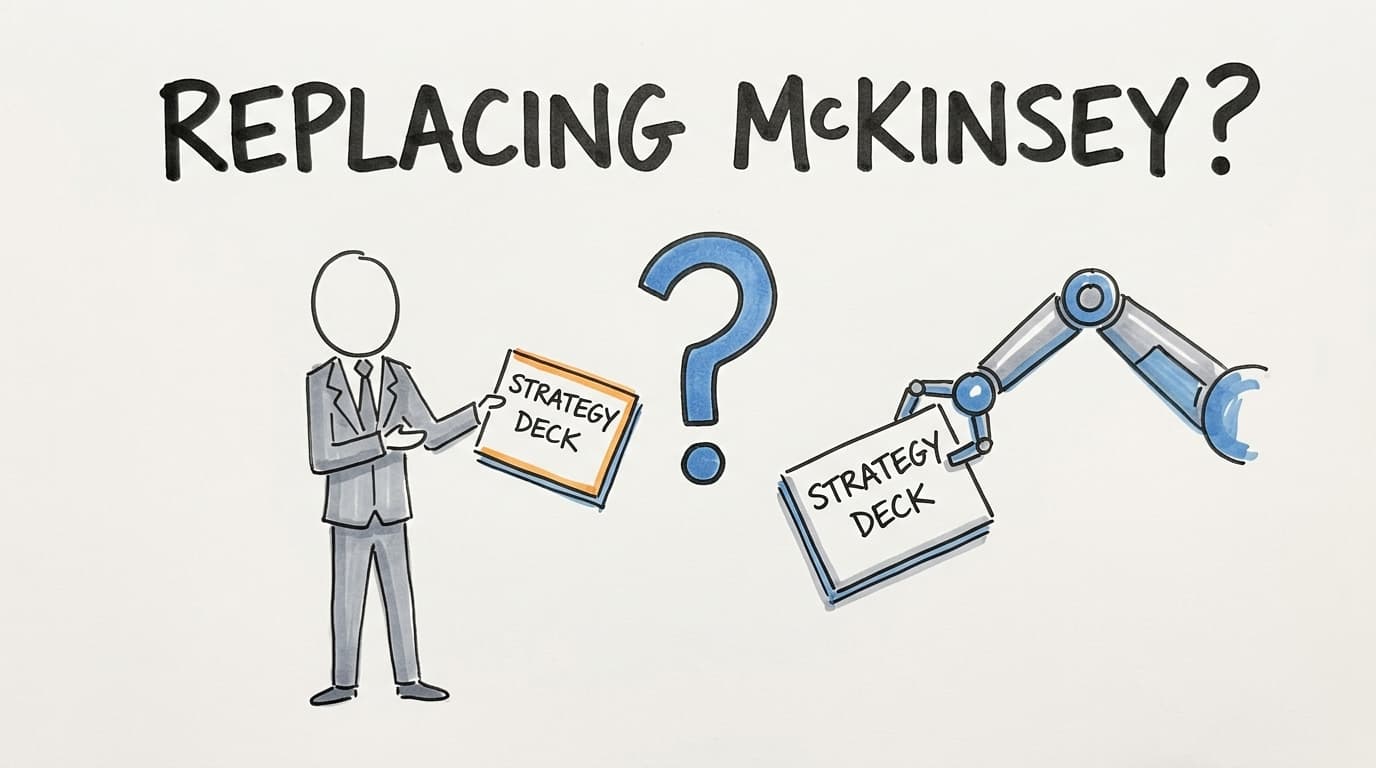
Every other post on LinkedIn seems to shout the same message: "Consulting is dead! AI is the new McKinsey!" It's a great headline. It's also mostly wrong.
From where I sit — at the intersection of tech product development and service delivery — the story is more complicated than replacement. McKinsey isn't being killed by AI. It's being squeezed by a shifting landscape where its traditional advantages are eroding from multiple directions at once.
McKinsey's Century-High Followed by a Plateau
For more than a decade, McKinsey surged ahead. From 2012 to 2023, revenue doubled. The growth wasn't organic — it was architectural. The firm acquired over 16 tech consultancies, including QuantumBlack (AI and analytics), LUNAR (design), Veryday (innovation consulting), and Iguazio (ML platform). They made a deliberate pivot from pure strategy advice to end-to-end execution.
By late 2023, that growth stalled. Revenue ticked up just 2% and headcount fell by around 5,000.
What happened? Expanding into execution requires more than acquiring capabilities — it demands actually integrating them. And that's where rivals moved faster.
BCG's Quiet Victory
Boston Consulting Group played a similar card — diversifying into digital and tech — but with better execution. The numbers tell the story: in 2012, McKinsey was roughly twice BCG's size. That gap has narrowed dramatically — and BCG has already overtaken McKinsey in headcount. At the current pace, BCG could overtake McKinsey in revenue within a few years.
As someone who's competed with and worked alongside both firms on implementation projects, I've seen why. BCG treats digital specialists as equal contributors. McKinsey's culture still, in many engagements I've witnessed, treats technologists as accessories to the strategy team. When your implementation partners feel like second-class citizens, the implementation shows it.
The Real Disruptors: Palantir and AI-Natives
Then there's the rise of Palantir and OpenAI, who aren't traditional consultancies at all. They offer powerful platforms — and send their engineers into the trenches.
Palantir is the most uncomfortable example. Revenue grew nearly 50% year-over-year in Q2 — but the growth comes from a model that should give anyone pause. Built on government surveillance contracts and predictive policing, Palantir now embeds engineers directly into enterprise clients, blurring the line between software vendor and strategic advisor. It's effective. It's also a company whose core business has been mass data collection on populations, often without meaningful consent or oversight.
The growth is real. But "compelling" isn't the word I'd use. CEOs love the results. The question is whether anyone is asking hard enough questions about the methods — and whether the consulting industry wants to compete by following Palantir into territory where the ethical lines are deliberately unclear.
What AI Actually Changes
AI will undoubtedly compress parts of the traditional consulting value chain. Data analysis and pattern recognition. Report and presentation generation. Preliminary market research. These are tasks consultancies traditionally staffed with armies of junior analysts.
But this raises a fundamental question: who is best positioned to deliver strategic judgment in this new ecosystem?
Not AI alone. Not yet. When clients pay premium fees to McKinsey or BCG, they're not buying access to analysis — they're buying interpretation, synthesis, and the persuasive narrative that drives organisational change. They're buying experience that knows which questions to ask the AI in the first place.
The consultancies that thrive will be those that embrace AI as a force multiplier for their true differentiator: strategic judgment informed by cross-industry pattern recognition.
My Take: Partnerships, Not Hybrids
Here's what I've observed across twenty years of watching product companies and service companies try to become each other:
Every time a SaaS company bolts on consulting, or a consultancy builds a half-baked platform, the customer loses. The product loses focus. The service becomes generic. And the results underwhelm.
At Mogul, I've lived this tension. We build custom LMS platforms — that's the product. But we also do the strategy, the content design, and the implementation. The reason it works is that the product and service were designed together from the start. Bolting one onto the other after the fact almost never produces the same result.
The future lies in symbiosis, not convergence. Product firms should own the tech, continuously improving and scaling it. Service firms should offer the context, the interpretation, and the pathway. Let each do what they do best.
Where I Land
McKinsey isn't being replaced. It's being challenged — by more agile competitors, by AI-native companies, and by its own overexpansion.
The firms that survive will be those that honour the boundaries between advice and execution, between product and service. Because when those roles are clear, the impact is real.
And that, in a world overwhelmed by AI hype, is the kind of clarity clients will always pay for.