
GPT-5: A Misunderstood Release or a Calculated Play?
I spent my weekend testing GPT-5. Not in a benchmark sense — I don't have a test suite — but in the way that matters: can this model do my actual work better than what I was using before?
The verdict is more nuanced than any headline will capture. GPT-5 isn't the revolutionary leap people expected. It might be something more important: the model that makes AI usable for everyone, not just power users.
The Unified System
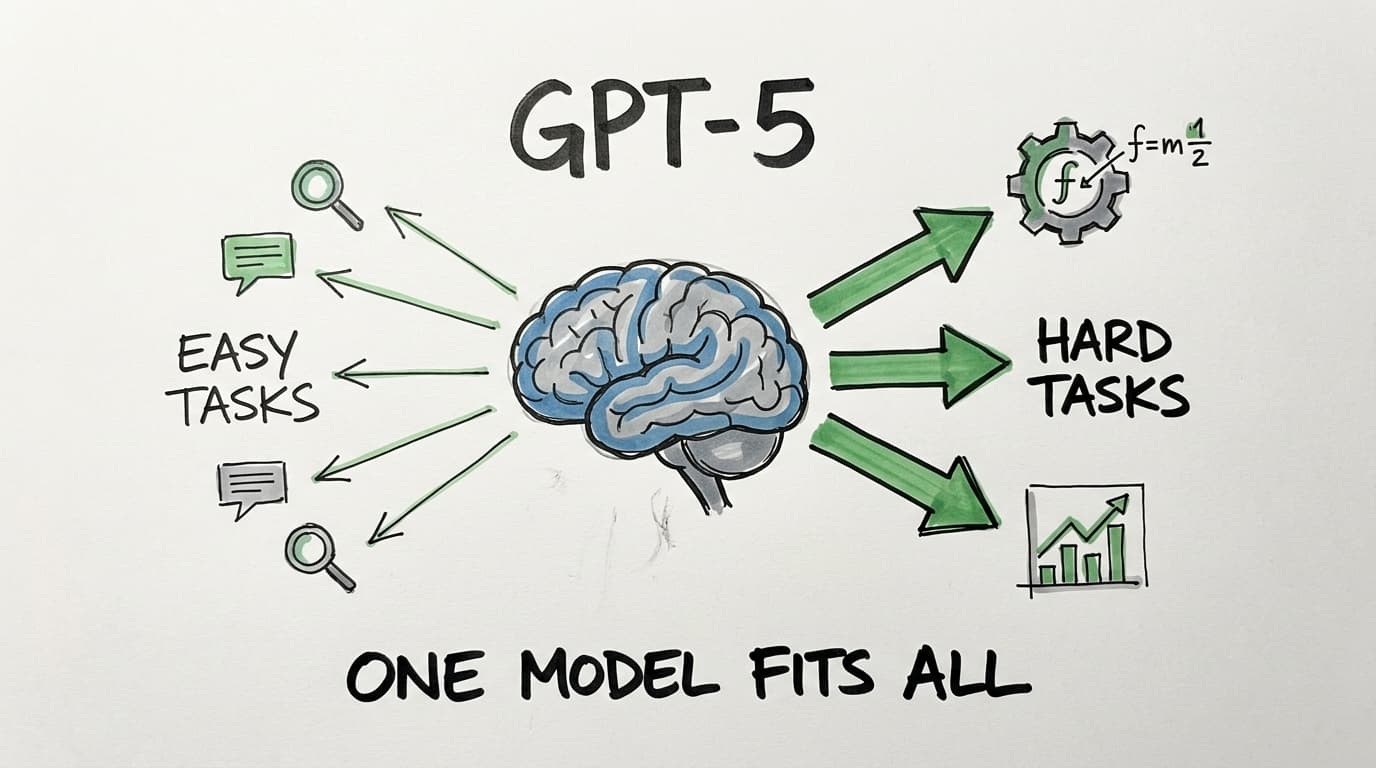
The biggest change isn't raw intelligence. It's architecture. GPT-5 consolidates o1, o3, o3-mini, and 4o into a single adaptive system. You don't choose a model anymore. The system chooses for you based on what you're asking.
For months, I've been complaining about model selection as a UX nightmare. Which model for coding? Which for analysis? Which for creative work? It was like ordering from a restaurant where the menu items are named after stormtrooper serials.
GPT-5 fixes this. You ask a question, and it routes to the right capability automatically. Simple queries get fast responses. Complex reasoning gets more compute. You never see the machinery.
This sounds minor. It isn't. The model selection problem was real friction that prevented normal people from using AI effectively. Removing it is a design decision, not an intelligence upgrade — and it might matter more than any benchmark improvement.
The Coding Test
I tested GPT-5 for coding in Windsurf for several hours. Impressively fast. Thoughtfully executed plans and reasoning chains. The step-by-step thinking summaries are genuinely useful — you can see the model working through options and tradeoffs before it writes code.
I was ready to stay exclusively with Claude Code, which I've been using and loving for months. GPT-5 gave me pause. Not because it's better across the board — it isn't. But the speed and the adaptive reasoning create a different workflow. Less waiting. More iteration.
I'll keep testing. My instinct says Claude Code still wins for complex, multi-step agentic work. But GPT-5 is genuinely competitive for focused coding tasks in a way that previous OpenAI models weren't.
The Health Angle
One detail caught my attention: GPT-5 includes health-focused capabilities. It can now provide more detailed health information with appropriate caveats.
This makes perfect sense from a data perspective. OpenAI can see what people actually use ChatGPT for. And health queries are almost certainly a massive category. I know from personal experience — when my daughter had a nasty bike crash last year, ChatGPT was the first thing I consulted while we figured out next steps.
The move toward health isn't just feature creep. It's product-market fit informed by actual usage data.
What's Missing
GPT-5 still doesn't have the persistent context that makes Claude Code transformative for me. Each conversation starts fresh. The adaptive reasoning is impressive within a session but doesn't carry across sessions.
For my workflow — where I need the AI to know my projects, my clients, my system state, my daily priorities — Claude Code's context persistence is still the killer feature. GPT-5 is smarter in some ways but doesn't know me.
Where I Land
I think GPT-5 is OpenAI's play for the mass market, not the power user market. The unified system removes friction for normal users. The health features address real demand. The adaptive reasoning means you don't need to understand AI to benefit from it.
For power users like me, it's a competitive option but not yet a replacement for Claude Code's agentic workflow. The models are converging in raw capability. The differentiation is increasingly about the surrounding system — context, tools, workflows, integrations.
GPT-5 isn't the moonshot everyone expected. It's the model that makes AI feel like a utility rather than a technology. And that might be exactly what the market needs right now.