
From SaaS to Custom: Why AI is Killing the One-Size-Fits-All Software Era
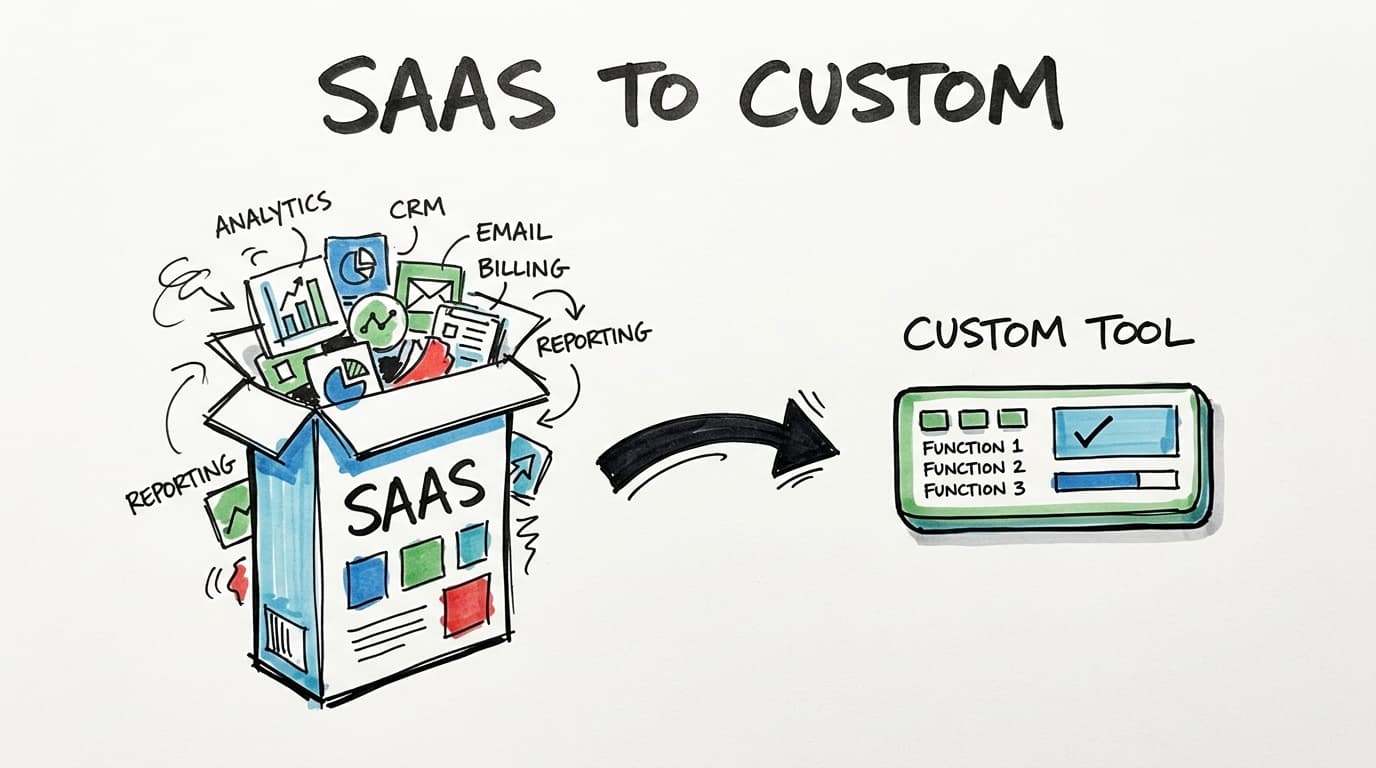
For the last decade, SaaS reigned supreme. Salesforce, Slack, HubSpot — these names became synonymous with digital transformation. And the reason was straightforward: it was simply easier to swipe a card and pay $30 a month per seat than to architect a solution in-house.
I spent years helping enterprise clients implement these tools. The pitch was always the same: faster to deploy, cheaper to maintain, someone else handles the updates. And it was true — for a while.
But the convenience came with costs nobody talked about. Bloat. Feature creep. Workflows designed for the average user of a million-user platform, not for your specific team. And the slow, grinding realisation that you'd traded control for convenience and were now locked into someone else's roadmap.
The Salesforce Problem
I always come back to Salesforce as the prime example. They captured a market, and then they forgot about the user.
Every Salesforce implementation I've been near has the same shape: six months of customisation to make it do what your business actually needs. A consultant bill that rivals the license fees. End users who hate it because the interface was clearly designed by committee and hasn't meaningfully improved since 2015. And a switching cost so high that leaving feels impossible even when staying feels painful.
That's not a CRM. That's a hostage situation with good marketing.
The irony is that Salesforce works despite the UX, not because of it. The data model is powerful. The ecosystem is vast. But the gap between what Salesforce could do and what it feels like to use it has been widening for years. They got comfortable, and now they're vulnerable.
What Changed
AI didn't just improve software development. It collapsed the cost-benefit equation that made SaaS the default choice.
A 30-person team with AI-enhanced development processes can now deliver what used to require 200 engineers and a year-long roadmap. Custom software is no longer a luxury for tech giants. The build-vs-buy calculation has fundamentally shifted.
I've seen this in my own work. At Mogul, we build custom learning management systems for tourism destinations. Two years ago, clients would ask "can't we just use Teachable?" Now they see what a custom platform can do — their branding, their data, their user experience — and the question doesn't come up anymore.
The custom solution isn't just better. It's becoming cheaper than the SaaS alternative once you factor in customisation, training, and the productivity cost of fighting a tool that wasn't designed for your workflow.
What Dies and What Survives
I don't think all SaaS companies will disappear. That's the lazy take. What I think is that the bloat gets killed.
The SaaS companies that survive will be the ones solving problems that genuinely benefit from network effects and shared infrastructure. Stripe makes sense as a platform — payment processing is complex, regulated, and benefits from scale. Figma makes sense — collaborative design needs a shared canvas.
What doesn't survive: tools that exist because building a custom version used to be hard. Project management tools that are really just fancy spreadsheets. Internal dashboards wrapped in a subscription. Analytics platforms that mostly reformat data you already have.
If the primary value proposition is "we built it so you don't have to," AI just undercut your entire business model. Because now your customers can build it too — faster, cheaper, and exactly the way they want.
The Uncomfortable Truth for IT
This shift demands a new mindset from IT departments. For a decade, the IT function has been primarily about procurement — evaluating vendors, managing licenses, negotiating enterprise agreements. The role was "which SaaS tools should we buy?"
The new question is: "what should we build?"
That's a fundamentally different skill set. It requires product thinking, not procurement thinking. It requires understanding your users well enough to know where a custom tool would outperform a generic one. And it requires the confidence to bet on your own team's ability to build and maintain something.
Not every organisation is ready for that. But the ones that are will have a significant advantage — because custom software that fits your workflow perfectly is a competitive moat that no SaaS competitor can replicate.
Where I Land
The SaaS era was built on convenience, and convenience is still valuable. I'm not deleting my Slack account.
But the era of defaulting to SaaS is ending. The first question should no longer be "which tool do we buy?" It should be "is this problem better solved by buying or building?" And increasingly, for anything core to your business, the answer is building.
AI didn't kill SaaS. It killed the assumption that building was always harder.