
The Collapse of Digital Complexity
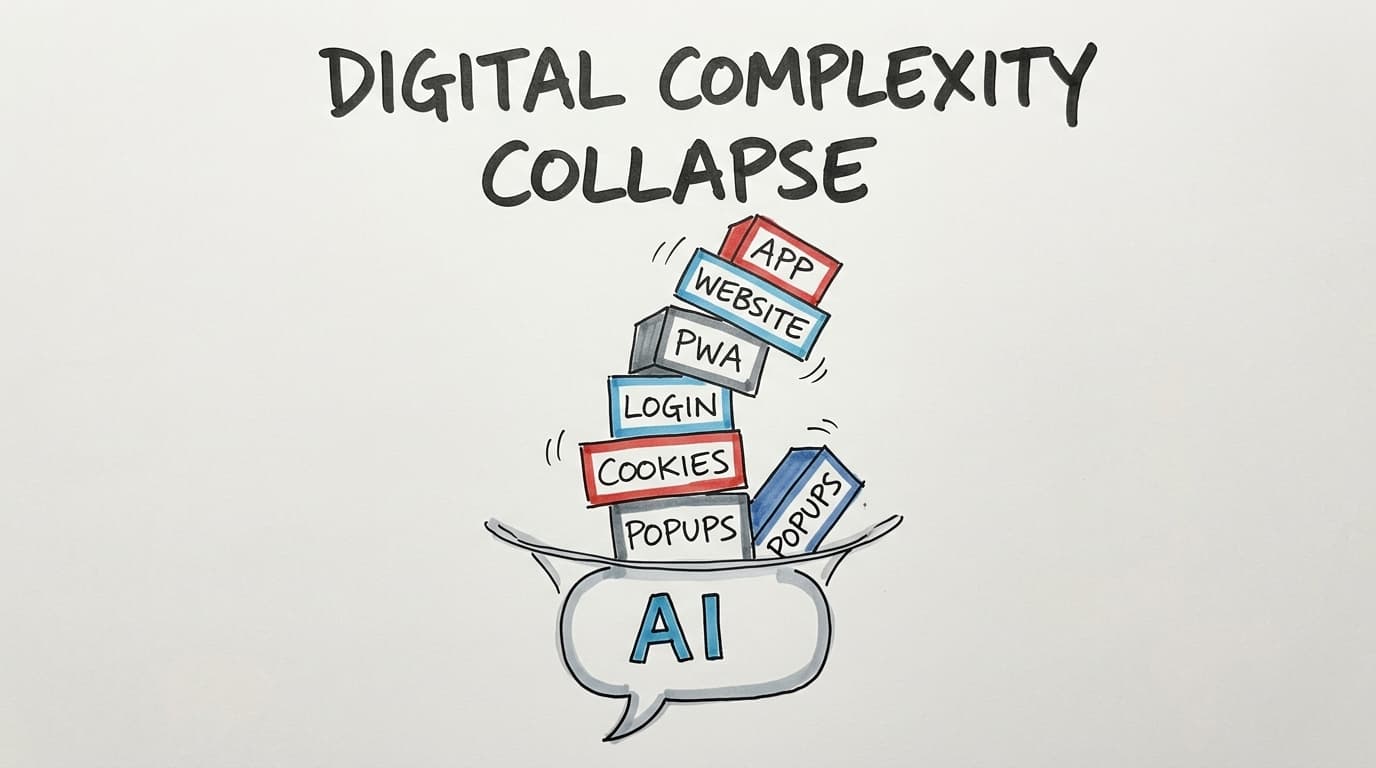
Joseph Tainter wrote a book in 1988 called The Collapse of Complex Societies. His thesis: civilisations don't collapse because of external threats. They collapse when the marginal return on complexity becomes negative. Each new layer of bureaucracy, infrastructure, or governance costs more than it returns — until the whole system buckles under its own weight.
The Mayans. The Romans. The Western Roman Empire.
I think we're at peak digital complexity right now. One layer away from collapse.
The Evidence Is Everywhere
Pick any brand and look at their digital presence. Website. iOS app. Android app. Web app. Progressive web app. They all do slightly different things. They have different bugs. Some features only exist on one platform. "Download our app for the full experience" is still a sentence that exists in 2025.
Then layer on the interaction overhead. Cookie consent popup. GDPR popup. Newsletter signup popup. Chat widget. App download banner. Five obstacles before you see the content you came for.
Login? Google. Apple. Email. SSO. Which password manager? Account settings in the app aren't the same as account settings on the web. Want to cancel your subscription? Good luck finding the button — it's deliberately buried three menus deep.
This isn't bad design by individual companies. This is systemic complexity that accumulated because each layer made sense in isolation. Each popup was a reasonable response to a regulation. Each platform was a reasonable response to a market. Each login method was a reasonable response to user demand.
But collectively, we've built something absurd. And everyone knows it.
Why AI Is the Collapse Trigger
Tainter's civilisations collapsed when a simpler alternative became viable. The Roman frontier regions didn't need Rome's complexity once they could govern themselves. The cost of the empire exceeded its benefit.
AI is the simpler alternative for digital complexity.
Instead of visiting a brand's website, navigating their information architecture, and finding the specific thing you need — you'll ask an AI assistant and get the answer. Instead of downloading an app, creating an account, and learning a new interface — you'll describe what you want and the AI will handle it.
The airline doesn't need a website, an app, a chatbot, and a phone line if an AI agent can book, change, and manage your flight through a conversation. The bank doesn't need seventeen menu items in a mobile app if the AI understands "how much did I spend on groceries last month?"
The entire multi-platform, multi-interface, multi-login architecture we've built over 20 years becomes unnecessary when the interface is language.
What Collapses First
Not everything. The complexity will peel away in layers.
Information retrieval collapses first. Nobody will browse a restaurant's website for their menu when an AI can just tell them what's on it. FAQ pages. Product specs. Store hours. Anything that's currently "go to the website and find it" becomes "just ask."
Transactional interfaces simplify next. Booking. Ordering. Scheduling. Anything where the current process is "fill out a form" becomes "describe what you want." The form was always an approximation of a conversation anyway.
Creative and exploratory interfaces survive longest. Shopping for clothes. Browsing real estate. Exploring travel destinations. These benefit from visual interfaces and serendipity. AI won't replace the pleasure of browsing — but it will replace the obligation to browse when you already know what you want.
The Part Nobody's Ready For
The companies that built their competitive advantage on digital complexity — the ones with the best apps, the most features, the stickiest ecosystems — are the most exposed.
Because the complexity was the moat. Lock-in was the strategy. Make switching hard enough and users won't leave, even if the experience is mediocre.
AI collapses switching costs. If an AI agent can interface with any service on your behalf, the brand's app doesn't matter anymore. The user interface becomes the AI's interface. And the AI doesn't care about your app's design system.
Where I Land
I'm not predicting the death of websites or apps. Not yet. But I am predicting that in 10-15 years, people will look back at the current era the way we look back at the early internet — with a mix of nostalgia and bewilderment.
"Wait, you had to go to each company's separate website? And create a different account for each one? And they all had different interfaces? And sometimes the website and the app did different things?"
Yes. And we accepted it because we didn't have a simpler alternative.
Now we're getting one. The collapse won't be dramatic. It'll be gradual — one unnecessary interface at a time, replaced by something that just works without making you think about it.
That's not a threat to designers. It's a liberation. The best design has always been invisible. AI might finally let us get there.