
Can You Trust an AI Agent? What Building One Taught Me
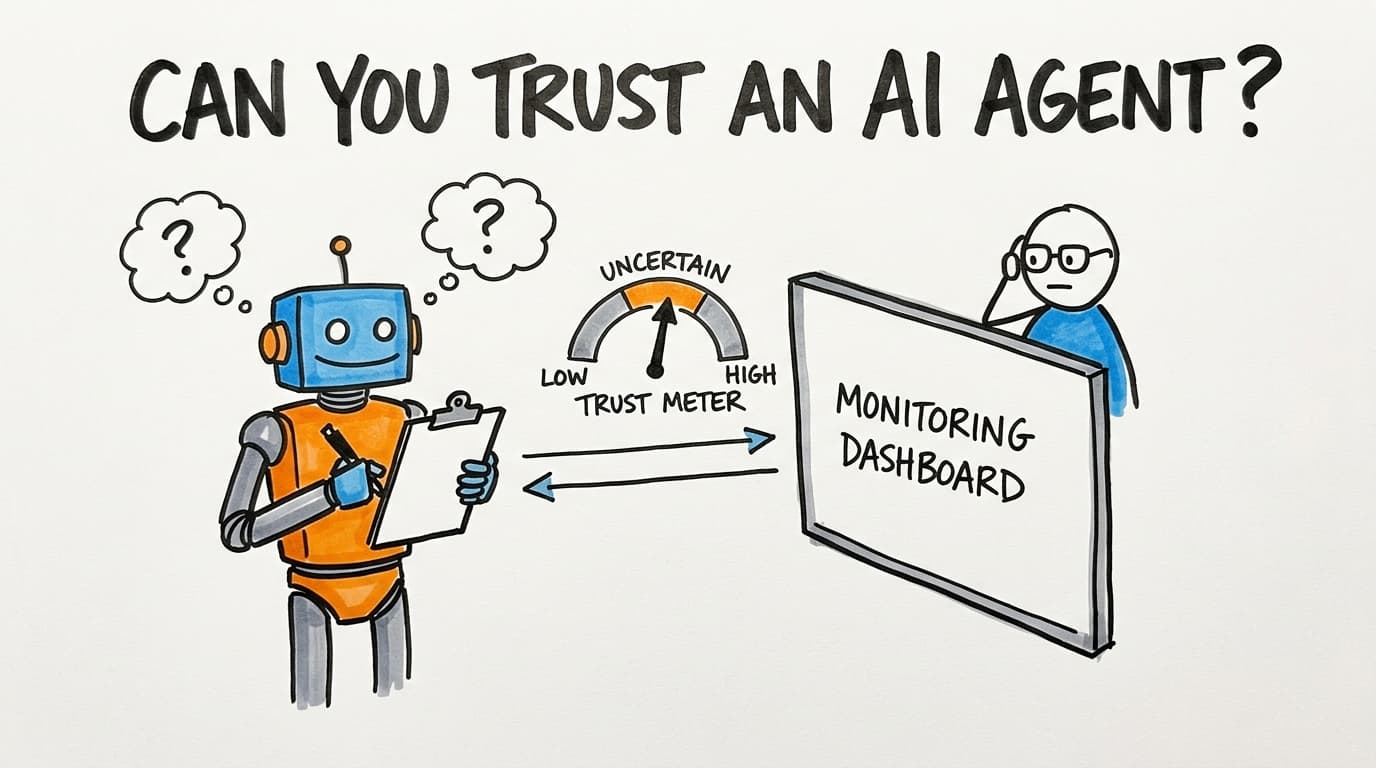
We built an AI support agent recently. It could process customer support emails, cross-reference sender information with project histories, leverage conversation memory, consult our support documentation, and then decide: reply directly, request more information, or create a developer ticket.
Building the basic functionality wasn't particularly complex. The challenge showed up later — at the border between "this works" and "we trust this to run on its own."
With limited historical support emails for training, we couldn't fully validate the agent's decision-making. But the bigger issue wasn't data. It was the unknown unknowns. What would it do with an email it had never seen before? What if it misclassified a critical issue as routine? What if it replied to a client with something technically accurate but tonally wrong?
We kept the human in the loop. And that experience taught me more about AI trust than any framework or whitepaper.
The Gap Between Capability and Control
Traditional AI models are reactive — they respond to prompts, produce outputs, and stop. Agentic AI is different. It interprets outputs as new inputs. It makes chain decisions based on goals. It operates without continuous human involvement.
This makes agents powerful for automating complex workflows. It also introduces unpredictability we're still learning to manage.
The testing problem is real. Unlike traditional code, which follows deterministic paths you can unit test, agentic AI behaves differently depending on context, input phrasing, and accumulated state. Small changes in input can drastically alter the outcome. An agent's choice today might cause a problem days later.
Where the Risks Actually Are
After building several autonomous and semi-autonomous agents, I've identified where things actually go wrong — and it's not where most frameworks predict.
The confidence problem. AI agents don't express uncertainty well. They execute decisions with the same confidence whether they're 99% sure or 50% sure. A human support agent would escalate an ambiguous email. An AI agent will choose an action and commit to it.
Cascading errors. In multi-step workflows, an early mistake compounds. Our support agent once misidentified a billing query as a technical issue, created a developer ticket, and drafted a technical response — all correctly executed based on the initial misclassification. Every step was logical. The premise was wrong.
Scope creep. Agents given broad goals find creative ways to achieve them. Sometimes that's brilliant. Sometimes it means the agent accessed a database it shouldn't have, or sent a communication you didn't expect. The broader the goal, the wider the risk surface.
What Actually Works
Three layers of protection have proven effective in practice.
Interruptibility. Can you stop the agent mid-task? This sounds basic but many agentic frameworks don't support it gracefully. We built a "pause and review" checkpoint into every workflow that touches external systems — email sends, ticket creation, database writes. The agent proposes the action. A human (or another system) approves it.
Audit trails. Every decision needs a traceable path backward. When our support agent creates a ticket, the full reasoning chain is logged — what email triggered it, what information was retrieved, what decision was made and why. When something goes wrong, you need to understand the chain, not just the outcome.
Monitoring dashboards. This is the piece I think most teams underestimate. Real-time visibility into what agents are doing — not just error rates, but decision patterns. Are support agents classifying more emails as "technical" than last week? Is the agent's reply tone shifting? These trend signals catch problems before they become incidents.
My Take: Supervised Autonomy
Full autonomy is a goal, not a starting point. The path there is supervised autonomy — agents that operate independently within bounds, with human oversight at critical junctions.
The companies that will succeed with AI agents are the ones that design for the failure mode, not just the happy path. That means building the observation layer as carefully as the capability layer. It means treating monitoring as a first-class product feature, not an afterthought.
And it means being honest about what you trust and what you don't. We trust our support agent to classify emails. We don't yet trust it to reply to clients without review. That's not a limitation — it's a design decision based on where the risk-reward balance actually is.
Where I Land
AI agents are powerful and they will transform enterprise workflows. But "set it and forget it" autonomy is years away for most applications. The near-term value is in supervised autonomy — agents that handle the routine while humans handle the exceptions.
The real infrastructure investment isn't in building better agents. It's in building better ways to watch them. Because in the end, AI doesn't hold the responsibility. We do.