
Autonomy, Mastery, Purpose: AI Won't Destroy Your Team. Your Rollout Will.
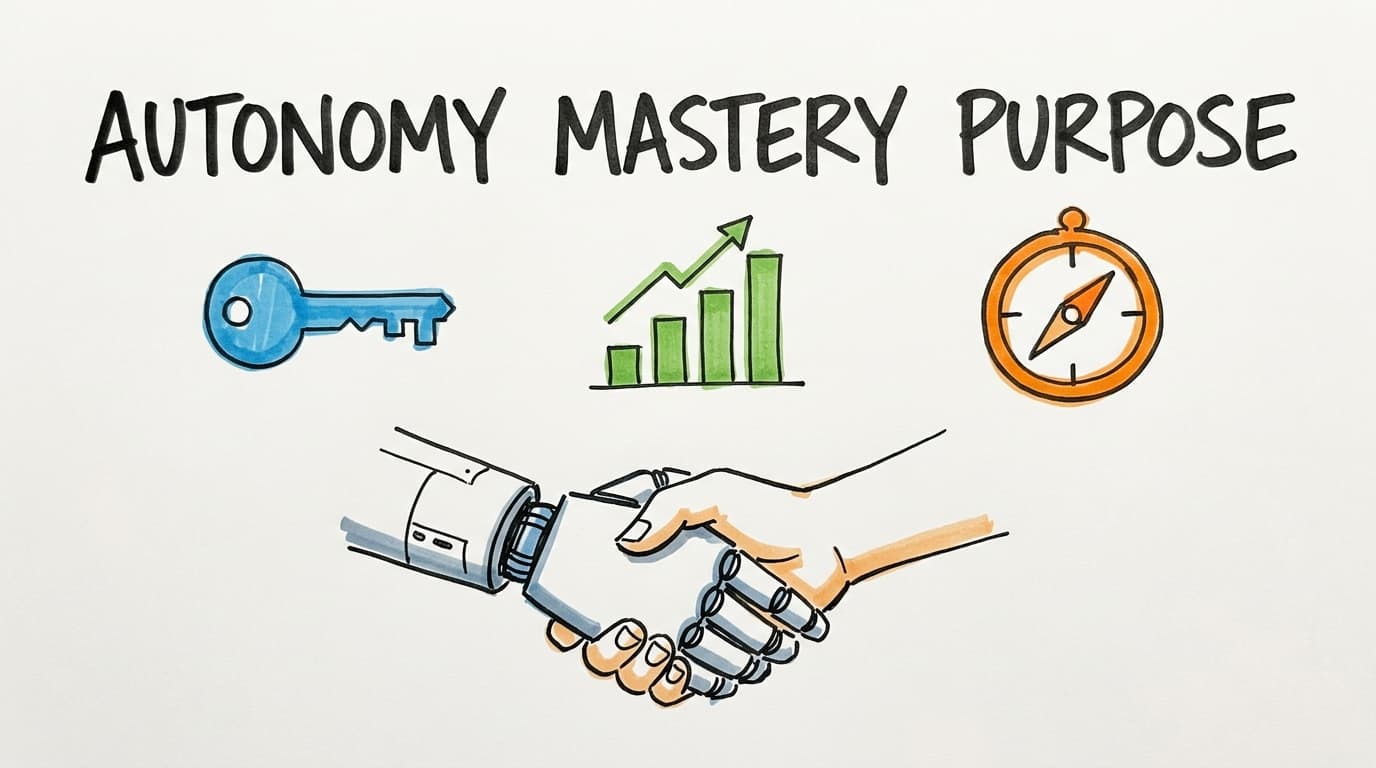
A few years ago, a friend of mine — Darren Keggan — told me about the three things that make a workplace actually work. Not ping pong tables. Not free lunch. Three intrinsic motivators that determine whether people do their best work or quietly disengage:
Autonomy. The freedom to decide how you work. Mastery. The drive to get better at something that matters. Purpose. The feeling that your work means something beyond a paycheck.
The framework comes from Daniel Pink's book Drive, and it's one of those ideas that, once you hear it, you can't unsee. Every great team I've worked on had all three. Every dysfunctional one was missing at least one.
I've been thinking about this a lot lately — because AI is about to stress-test all three at the same time.
The Double-Edged Sword
Here's what most AI discourse gets wrong: it frames the technology as inherently good or bad for workers. "AI will free you from busywork!" versus "AI will take your job!"
The truth is messier. The same AI tool — the exact same tool — can either amplify these three motivators or destroy them. The difference isn't the technology. It's the rollout.
Autonomy: Amplified or Annihilated
When AI handles the tedious parts of a job — data entry, boilerplate reports, scheduling — it can give people more time for the work they actually chose to do. That's autonomy amplified.
But when AI is deployed as a surveillance tool — monitoring keystrokes, scoring productivity, flagging "unproductive" time — it strips autonomy entirely. You're not choosing how to work anymore. You're performing for an algorithm.
I've seen both in my consulting work. One client used AI to automate their travel agents' administrative tasks, giving them more time for client relationships. Another used it to score call centre agents on "sentiment adherence" in real time. Same technology category. Completely opposite effect on the people using it.
Mastery: The Skill Erosion Question
This is the one that keeps me up. AI can accelerate mastery — when a junior developer uses Claude Code to understand why a particular architecture decision was made, they're learning faster than reading documentation alone.
But AI can also bypass mastery entirely. If you never struggle with the problem, you never build the intuition. The Anthropic study on AI coding assistants showed exactly this: developers who relied on AI scored 17% lower on comprehension tests than those who coded manually.
The distinction is whether AI is used as a teacher or a replacement. A calculator makes you worse at arithmetic if you never learn long division. But it makes you better at mathematics if you already understand the concepts and use the tool to go further.
Leaders need to think carefully about which tasks their teams should struggle with and which should be automated. The answer isn't "automate everything." It's "automate the tasks where struggle doesn't build skill."
Purpose: The Meaning Crisis
This is the hardest one. Purpose comes from feeling that your work matters — that it connects to something bigger than the task itself.
AI threatens purpose in a subtle way. If a copywriter's drafts are now "first passes" that AI edits into final form, does the copywriter still feel like a writer? If a designer's wireframes are generated by AI and then "approved" by the designer, is that design work or quality control?
The answer depends entirely on framing. If the team understands AI as a tool that handles the mechanical parts so they can focus on judgment, creativity, and strategy — purpose survives. If AI is positioned as "the thing that does your job, and you're here to check its work" — purpose collapses.
What a Good Rollout Looks Like
I've been involved in enough AI implementations to know what works and what doesn't. The pattern is consistent.
Start with the pain, not the technology. Ask your team: what part of your job do you wish would disappear? Start AI there. When people see AI eliminating the thing they hated, they welcome it.
Protect the craft. Every role has tasks that build skill and tasks that are pure overhead. Automate the overhead. Protect the craft. A developer should still architect solutions. A designer should still interview users. A writer should still find the angle.
Be honest about the change. The worst rollouts are the ones where leadership insists "nothing is changing" while everything changes. People aren't stupid. If AI is going to restructure workflows, say so — and involve the team in deciding how.
Measure what matters. Not just productivity. Engagement. Skill development. Satisfaction. The team that ships 30% more features but hates their jobs isn't a success story. It's a ticking clock.
Where I Land
AI isn't a threat to teams. Bad implementation is. The technology is genuinely neutral — it amplifies whatever dynamics already exist. Teams with strong autonomy, mastery, and purpose will use AI to become exceptional. Teams already struggling with those fundamentals will find AI accelerates the dysfunction.
The leaders who get this right won't be the ones who deploy AI fastest. They'll be the ones who deploy it most thoughtfully — preserving what makes work meaningful while eliminating what makes it tedious.
That's not a technology challenge. It's a leadership one.