
AI Philosophy, Consciousness, and Ethics — A Practitioner's Guide
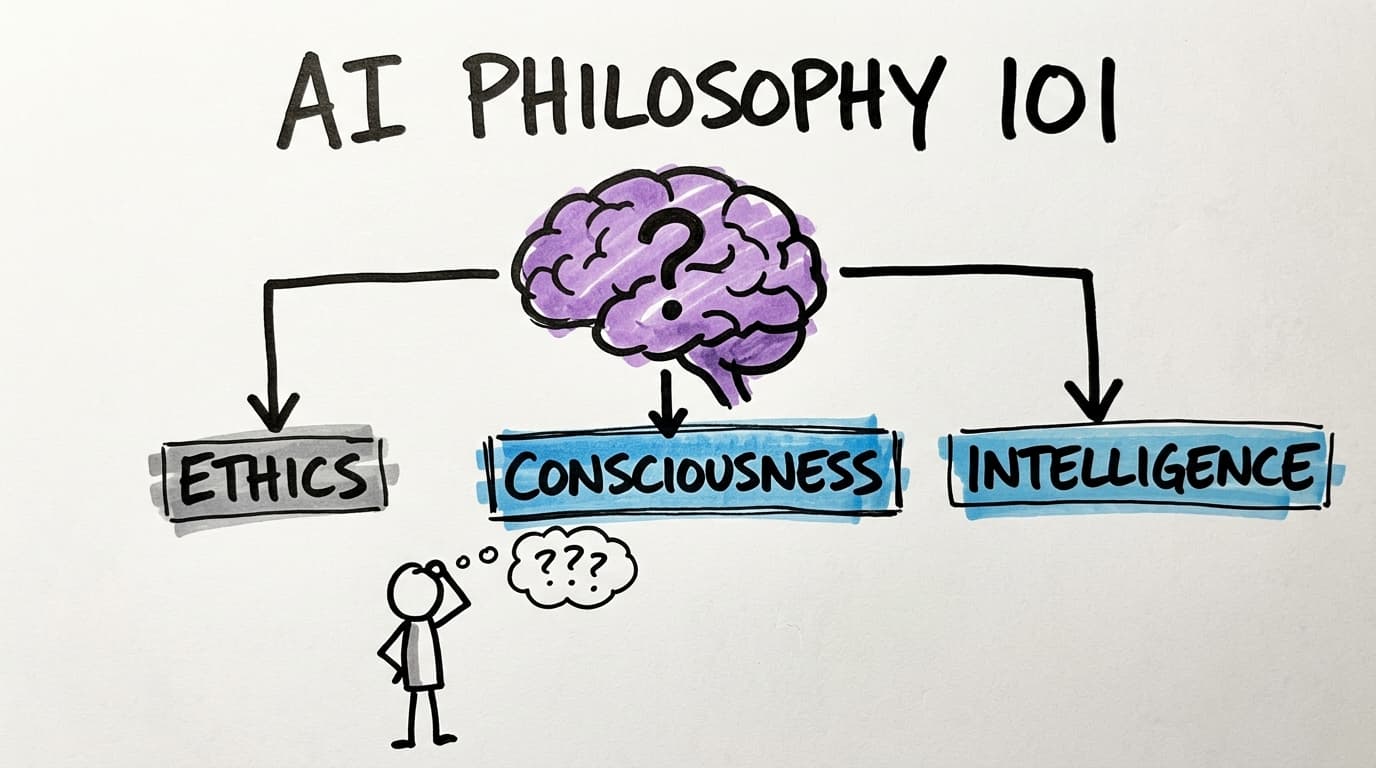
Back when I studied Computing Science at Glasgow University at the turn of the millennium, AI was already a significant field. I created some elementary learning systems as part of my coursework in 2001. We debated consciousness, the Chinese Room argument, and whether machines could ever truly "think." These felt like intellectual exercises — fascinating but distant from practical reality.
Twenty-five years later, those same questions are on the front page of every newspaper. And they're no longer academic. They're operational decisions that tech professionals make every day.
Why Philosophy Matters for Builders
If you're designing AI-powered products, you're making philosophical choices whether you know it or not. Every guardrail is an ethical position. Every dataset reflects values. Every deployment decision carries assumptions about what AI should and shouldn't do.
Understanding the philosophical foundations isn't academic nitpicking. It's the difference between building trustworthy systems and building systems that happen to work until they don't.
The Definition Problem
We still can't agree on what "intelligence" means. Turing proposed a behavioural test — if it looks intelligent, treat it as intelligent. Searle argued with the Chinese Room thought experiment that simulating understanding isn't the same as understanding. Modern approaches like the Frame Problem show that even defining "common sense" for machines is extraordinarily hard.
This matters practically because how you define intelligence determines what you build toward. If intelligence is behaviour, you optimise for output quality. If intelligence requires understanding, you need a fundamentally different architecture. Most current AI systems are firmly in the "behavioural" camp — they produce intelligent-looking outputs without anything resembling comprehension.
Consciousness: The Hard Problem
Can AI be conscious? Probably the wrong question. The right question is: does it matter for the systems we're building today?
I think it matters less than people assume for current applications, and more than people assume for future ones. Today's language models don't have subjective experiences. They process tokens. But as systems become more autonomous — making decisions, taking actions, operating without human oversight — the question of what's happening "inside" becomes less philosophical and more practical.
If an autonomous AI agent makes a harmful decision, who's responsible? The developer? The company? The AI? These aren't abstract questions anymore. They're legal ones, and the answers depend partly on what we believe about the system's "understanding" of its actions.
The Ethics We Actually Face
Forget trolley problems. The real ethical questions in AI are mundane and everywhere.
Bias: Your training data reflects historical patterns. If you train a hiring model on past hiring data, you encode past discrimination. This isn't a hypothetical — it's happened repeatedly, and the fix isn't just "better data." It's a fundamental question about what "fairness" means and who gets to define it.
Transparency: Should users know when they're interacting with AI? My position: always. The moment you hide the AI, you're making a trust decision on the user's behalf. That's a design choice with ethical weight.
Access: AI tools are expensive. The best models cost money to use. This creates a world where AI augments the already-skilled and already-resourced, widening gaps rather than closing them. Open-source models help, but the most capable systems are still behind paywalls.
Autonomy: How much should AI decide without human oversight? My experience building autonomous agents says: less than you think, more than you fear. The right boundary depends on the stakes, and most teams set it wrong in both directions.
What I've Learned from Building
Twenty-five years of thinking about AI philosophy and five years of building with it have taught me one thing clearly: the technology moves faster than the ethics.
Every AI system I've built has raised questions I hadn't considered in advance. Authentication agents that could impersonate users. Research tools that synthesised information in ways that obscured sources. Productivity systems that collected personal data as a side effect of being useful.
None of these were malicious. They were engineering decisions that had ethical implications I didn't fully anticipate. And that's the norm, not the exception.
Where I Land
Philosophy won't give you a checklist for building ethical AI. But it will give you a framework for asking better questions — and the awareness that those questions exist before you discover them in production.
If you build AI products, you owe it to your users to understand what consciousness means (even if we can't agree), what fairness requires (even if we can't fully achieve it), and what transparency demands (even when it's inconvenient).
The questions I debated in a Glasgow lecture hall in 2001 are now design decisions. The only difference is the stakes.