
The AI Job Market in 2026: What the Data Actually Says
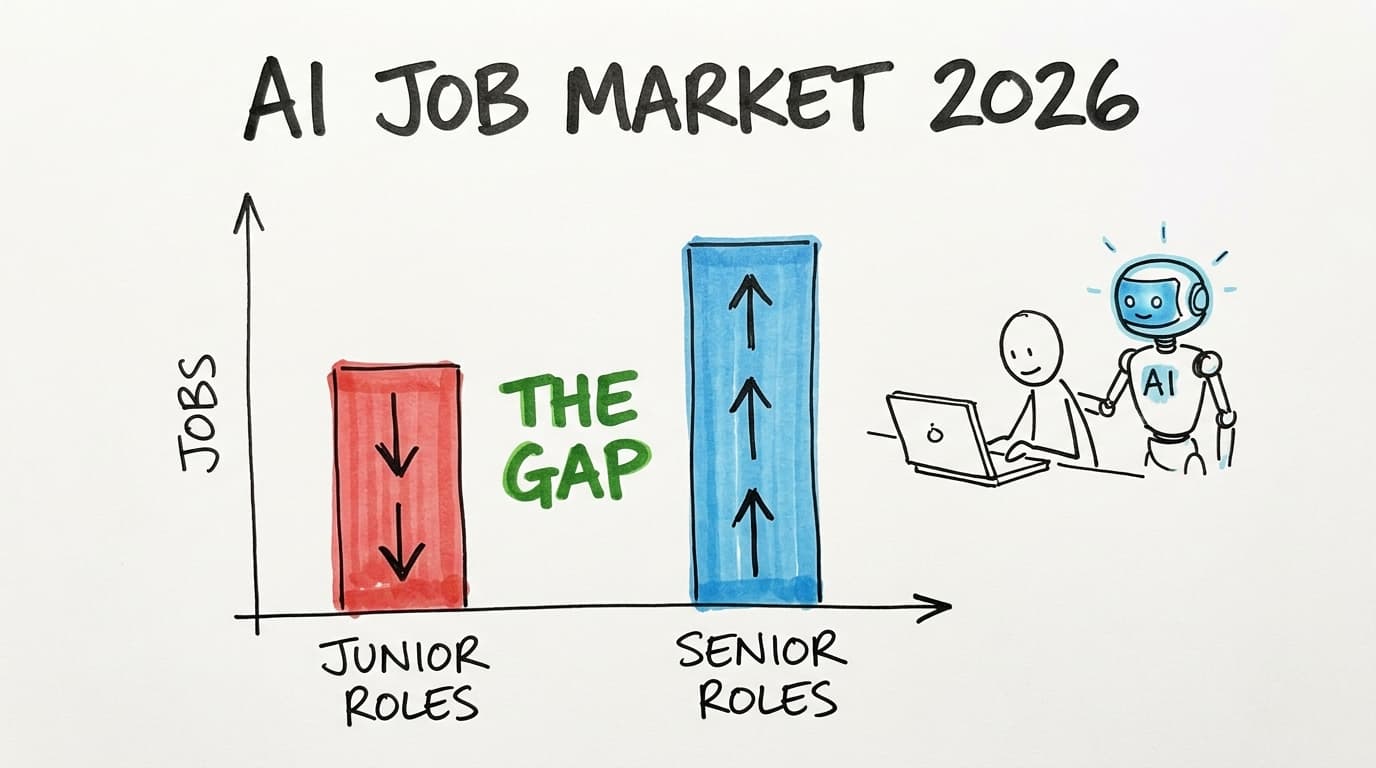
Anthropic's own research shows AI is theoretically capable of handling 94% of software engineering tasks. In practice, it's handling about 33%. And yet the junior developer job market has already collapsed.
That gap — between what AI can do and what it's actually doing — is where the real story lives. And it's more nuanced than either the doomers or the optimists want to admit.
The Headline vs. The Reality
The "AI is replacing developers" narrative gets clicks. So does "AI will never replace human creativity." Both are lazy takes that ignore what's actually happening on the ground.
Here's what the data says: AI isn't replacing developers wholesale. It's reshaping what developers do and which developers get hired. The impact is uneven, concentrated at the junior end, and accelerating.
Junior developer roles have contracted significantly. Not because AI can do the work perfectly — it can't. But because AI can do it well enough that hiring managers are reducing entry-level headcount and redistributing that work to senior developers augmented with AI tools.
The math is simple: one senior developer with Claude Code can do the work that used to require one senior and two juniors. The senior's productivity increased. The juniors' roles evaporated.
The Skills That Matter Now
The shift isn't from "coding" to "no coding." It's from "writing code" to "directing AI that writes code." That sounds similar. It isn't.
Directing AI effectively requires system-level thinking — understanding architecture, data flows, and tradeoffs at a level that most junior developers haven't developed yet. It requires the judgment to know when AI output is correct and when it's plausibly wrong. And it requires communication skills — the ability to describe complex requirements precisely enough that an AI can implement them.
These are senior skills. Which is exactly why the junior market is contracting.
What This Means for New Developers
If I were starting my career today, I'd be worried. Not because the career is dead — it isn't — but because the entry ramp has narrowed dramatically.
The traditional path — learn to code, get a junior role, grow through mentorship and increasing responsibility — assumed that junior-level tasks would always exist. AI is removing many of them. The tasks that remain are harder, more judgment-intensive, and require skills that take years to develop.
My honest advice: build things. Ship things. Not tutorials or code-along projects — actual products that solve actual problems. The portfolio has always mattered more than the degree, and that's now even more true. The developers who will get hired are the ones who can demonstrate judgment, not just syntax.
What This Means for Experienced Developers
If you're a senior developer or tech lead, AI is a force multiplier. You're more valuable than ever — but the expectation of what you can produce has also increased.
I ship enterprise applications faster than I ever have. Tahiti LMS, Grenada LMS, Kenya tourism platform — all in the last six months. That's not because I work more hours. It's because AI handles the implementation while I focus on architecture and product decisions.
But the flip side is real: my clients now expect that pace. The bar has risen for everyone. You're not competing against other developers anymore. You're competing against other developers with AI.
The Honest Middle Ground
AI isn't making developers obsolete. It's making some developer tasks obsolete. The developers who did those tasks — primarily juniors — need to level up faster or find different tasks to do.
The industry hasn't figured out how to handle this transition well. Bootcamps are still teaching the old model. Universities are still preparing students for junior roles that are shrinking. Companies are still hiring like it's 2023 while expecting 2026 productivity.
Something has to give. Either the education pipeline adapts, or an entire generation of aspiring developers gets caught in the gap between what they were trained for and what the market actually needs.
Where I Land
I'm optimistic for the career long-term. The demand for software isn't shrinking — it's exploding. AI makes it possible to build more, faster, and better. That creates opportunity.
But I'm not optimistic about the transition. The path from "aspiring developer" to "productive developer" is harder than it's ever been, and the industry isn't being honest about that. Pretending AI is just a helpful tool that doesn't change the job market is as dangerous as pretending it's going to replace everyone.
The truth, as usual, is in the middle. And the people who navigate it best will be the ones who see it clearly.