
AI Isn't Killing Software — It's Killing the Bloat
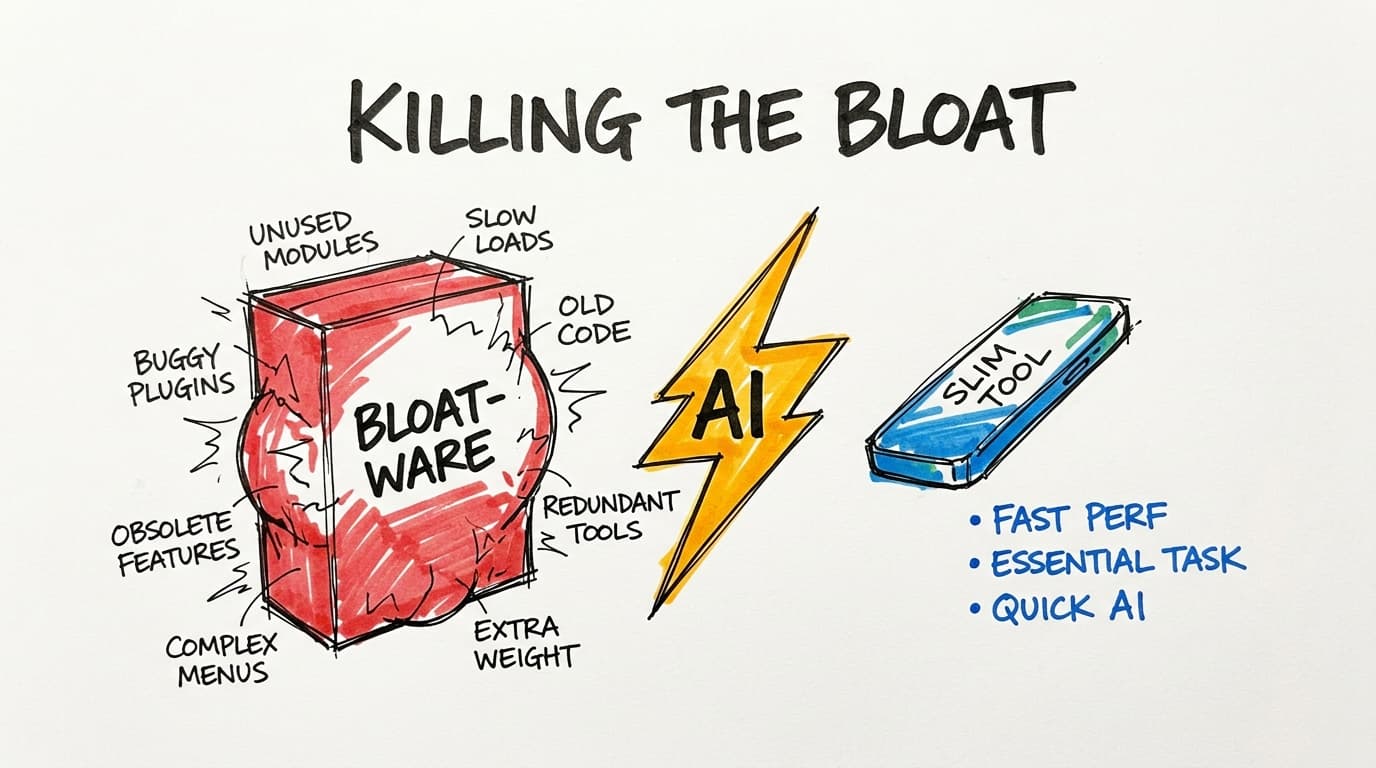
There's a panic spreading through the software industry. AI is going to kill SaaS. AI is going to replace apps. AI is going to make software engineers obsolete. Investor sentiment is tanking. Software multiples are compressing. The sky, apparently, is falling.
I think the panic is half right. AI will kill some software. Specifically, it will kill the software that deserved to die anyway.
The Bloat Problem
Raise your hand if you've used a SaaS tool that felt like it was designed by a committee that had never actually used it for real work. Now keep your hand up if that tool was Salesforce.
Salesforce is my go-to example of a company that captured a market and then forgot about the user. The CRM is powerful — the data model is genuinely impressive. But the interface looks like it was designed for an alien species that communicates through nested dropdown menus. Every implementation I've been near required months of customisation, a consultant army, and a training programme for features that should be intuitive.
And Salesforce isn't alone. The entire enterprise SaaS ecosystem is bloated with tools that prioritise feature count over usability, that ship for the investor deck rather than the user, and that rely on switching costs rather than satisfaction to retain customers.
That's what AI is going to kill. Not software. The bloat.
Why Bloat Survives (Until Now)
Bloated software survived for a simple reason: the alternative was worse. Building custom tools was expensive, slow, and risky. Maintaining them was a burden most companies couldn't sustain. So you paid $150/seat for a tool that did 80% of what you needed and 200% of what you didn't.
The switching cost calculation was brutal. Even if a competitor was better, migrating your data, retraining your team, and rebuilding your integrations made staying put the rational choice. The bloat was protected by inertia.
AI changes both sides of that equation. Building custom tools is now dramatically cheaper and faster. And the cost of staying with bloated software is becoming more visible as teams see what focused, well-designed AI tools can do.
What Dies
Tools that exist because building a custom version used to be hard. Internal dashboards wrapped in subscriptions. Analytics platforms that mostly reformulate data you already have. Project management tools that are fundamentally fancy to-do lists.
If the primary value proposition is "we built it so you don't have to," that's no longer a moat when AI lets you build it in an afternoon.
What Survives
Not everything is vulnerable. Software that benefits from network effects — Figma, Slack, GitHub — has value that goes beyond the tool itself. It's the collaboration, the community, the ecosystem. AI can't replicate that.
Software that handles genuine complexity — Stripe for payments, AWS for infrastructure, Shopify for commerce — has deep domain expertise baked in. You don't want to build your own payment processor, even if AI makes it theoretically possible.
The survivors will be tools that do something genuinely hard, do it well, and respect the user while doing it. The casualties will be tools that coasted on complexity, switching costs, and the assumption that their customers had no alternative.
Where I Land
I don't think all SaaS companies will disappear. That's the lazy take. What I think is that the market is about to experience a brutal quality filter. The products that are genuinely good — useful, well-designed, worth the money — will be fine. The products that have been riding on inertia and captive customers will face an existential challenge.
For the first time, their customers have a realistic alternative to tolerating bad software. That alternative is building exactly what they need, at a fraction of the cost, in a fraction of the time.
AI isn't killing software. It's killing excuses.