
AI Coding's Pricing Crisis: The Claude Code Problem
Last month I got my Claude Code bill. Four hundred dollars. I'd been running background agents on three client projects simultaneously — Tahiti, Grenada, and a Kenya admin rebuild — and the tokens had piled up faster than I'd tracked.
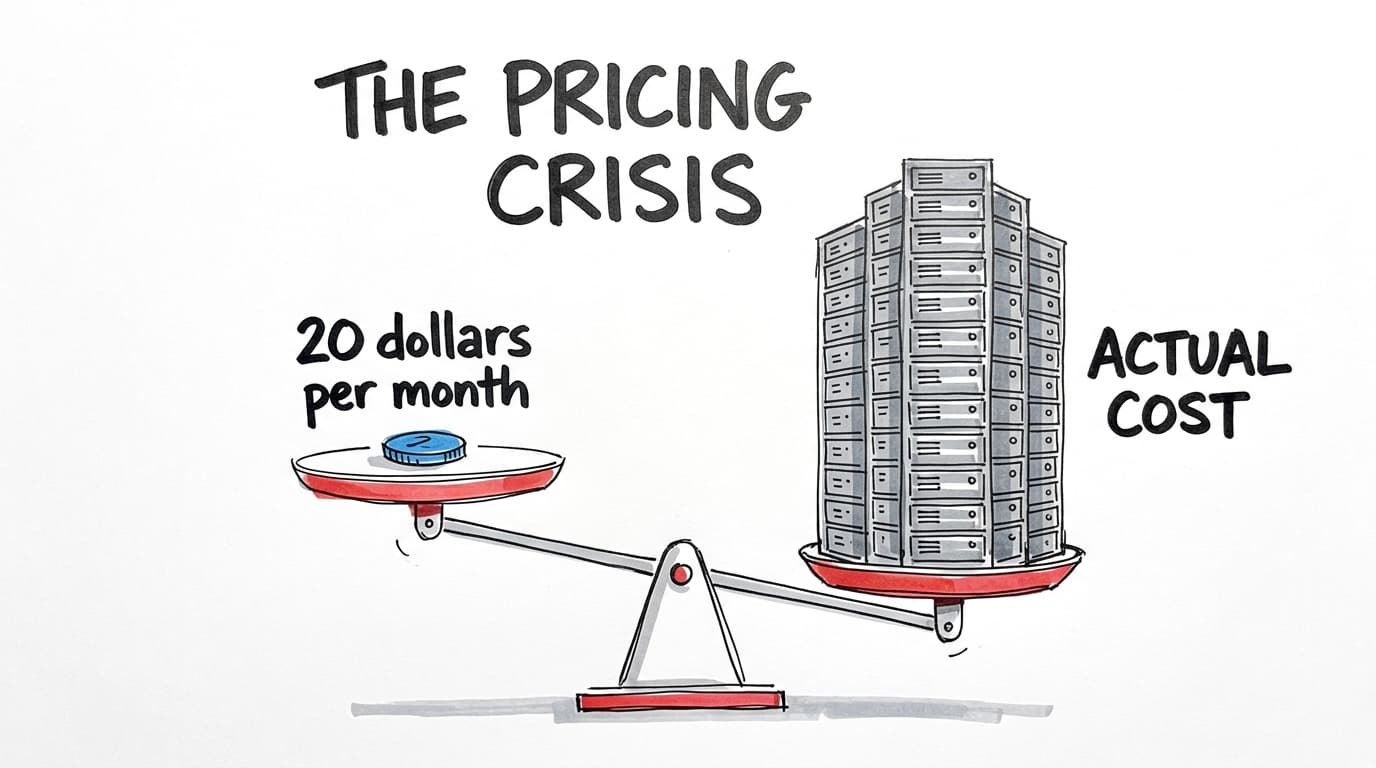
Here's the thing: I didn't feel ripped off. I'd shipped more in that month than most solo consultants ship in a quarter. The problem wasn't the price I paid. The problem is that Anthropic almost certainly lost money on me.
That gap — between what power users consume and what any reasonable subscription can charge — is the defining economic tension in AI tooling right now. And nobody has solved it.
The Mismatch Nobody Talks About
Every AI coding tool on the market is running the same uncomfortable maths. Cursor charges $20/month. Replit charges $25. Claude Code's Pro tier is $20. These prices were set when AI assistance meant occasional autocomplete suggestions and the odd chat query.
That's not how anyone uses these tools anymore.
I run Claude Code as an orchestration layer. It reads project files, spins up subagents, reviews pull requests, generates entire feature branches, and runs overnight tasks. A single session can burn through thousands of API calls. Multiply that across three active client projects and the token consumption is closer to what a small company would use, not a solo developer.
The flat subscription model was designed for human-paced interaction. What we've got now is machine-paced consumption on human-priced plans.
Why Dropping Prices Won't Fix It
The optimistic narrative goes like this: inference costs are falling, models are getting cheaper, so the economics will sort themselves out. Give it time.
I don't buy it. And here's why.
Every time inference gets cheaper, developers use more of it. When Claude got faster, I didn't save money — I started running more agents in parallel. When Cursor improved their autocomplete, developers didn't use it less. They started expecting it in every file, on every keystroke.
This is Jevons paradox playing out in real time. The same pattern that happened with cloud compute, with bandwidth, with storage. Efficiency gains don't reduce consumption — they increase it. Demand is elastic in exactly the wrong direction for anyone hoping cost reductions will bail out flat-rate pricing.
Chris Paik at Pace Capital put it well: product-market fit without business-model-product fit is a mirage. These tools are genuinely useful. People love them. They also can't be profitably sold at $20/month to the people who love them most.
We've Seen This Movie
MoviePass charged $10/month for unlimited cinema tickets. It was wildly popular. It was also burning cash at a rate that made venture capitalists physically uncomfortable. The product was great. The economics were impossible.
ClassPass tried the same thing with gym classes. Oyster tried it with books. In every case, the pattern was identical: flat pricing on a variable-cost service attracts the heaviest users first, and the heaviest users are the ones who blow up the model.
AI coding tools are running the exact same playbook. The $20/month Cursor subscriber who uses it for light autocomplete is subsidising the power user who's running multi-file refactors all day. That cross-subsidy works until the power users outnumber the casual ones — and in AI coding, that tipping point is approaching fast because the tools keep getting better at encouraging heavy use.
What Comes After Subscriptions
Some companies are already experimenting. SoftGen pivoted to cost-plus transparent pricing — you see exactly what the inference costs and pay a markup. It's the Costco model: we're not hiding the margin, and we're not pretending unlimited means unlimited.
Anthropic's own pricing tells the story. Claude Code launched with a $20/month Pro plan. Then they added a $200/month Max plan. Then Max 5x at $100/month (with a different model allocation). They're feeling their way toward usage-based pricing without calling it that — because "unlimited" is still better marketing than "metered."
I think the end state looks more like AWS than Netflix. Per-token, per-task, per-agent-minute pricing. Not because companies want to meter their users, but because the alternative — absorbing exponentially growing inference costs behind a flat fee — isn't a business. It's a countdown.
The Part That's Uncomfortable
Here's where I have to be honest about my own position: I benefit from the current mispricing. That $400 month? If Anthropic charged me what my usage actually cost in compute, it would have been closer to $1,200. Maybe more. The flat-ish pricing is subsidising power users like me, and I'm not complaining.
But I also build products for a living, and I know this shape. When the subsidy ends — and it will end — the tools don't disappear. They just get more expensive, or more restricted, or both. The developers who've built their entire workflow around unlimited AI assistance are going to face a reckoning.
The question isn't whether AI coding tools are worth paying more for. They obviously are. The question is whether the industry can transition from "growth at all costs" pricing to "sustainable business" pricing without losing the users who made the tools good in the first place.
Where I Land
I don't think this is a bubble in the traditional sense — the utility is real, and it's not going away. But the economics are a house of cards built on venture subsidies and the assumption that inference costs will fall faster than usage grows. That assumption is wrong.
The companies that survive will be the ones that find honest pricing — transparent, usage-aligned, and fair enough that power users don't feel punished for using the product the way it's designed to be used. That's a harder design problem than building the AI itself.
In the meantime, I'm going to keep running three agents in parallel on my client projects. The ROI is too good to stop. But I'm not going to pretend that $20/month is a price that makes sense for what I'm consuming.
Something has to give. And when it does, the developers who understood the economics early will be the ones who adapt fastest.