
Why "95% of AI Pilots Fail" Makes Headlines — And What It Really Means
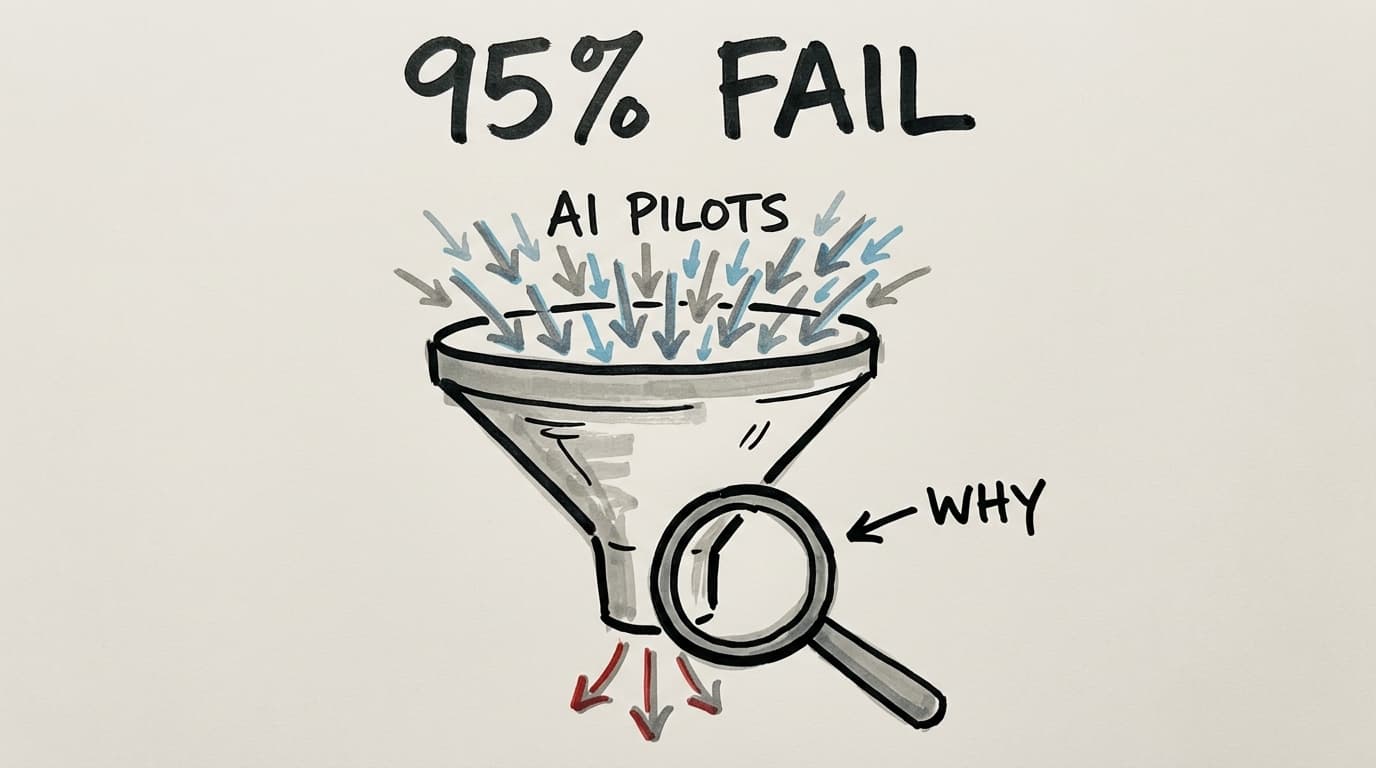
Every so often, a statistic explodes across LinkedIn and business press with the force of gospel truth. "95% of AI pilots fail" is the latest. It comes from an MIT NANDA report — serious research examining hundreds of enterprise AI deployments. The headline is stark, almost designed to go viral.
But what do these numbers really mean? And more importantly, what should leaders actually take away from them?
The Optimist's View
Pilots are supposed to fail. That's the whole point. Just like clinical trials in medicine, early-stage AI pilots are experiments. A 95% failure rate in experiments isn't alarming — it's expected. If most of your pilots succeed, you're not being ambitious enough.
The pilots that fail produce signal. They tell you what your data looks like in practice. They reveal where your infrastructure falls short. They expose the gap between what AI can do in a demo and what it can do with your messy, real-world data.
A 95% failure rate with clear learnings is infinitely more valuable than a 100% success rate on trivial use cases that don't move the needle.
The Skeptic's View
But let's be honest about what "failure" often looks like in enterprise AI. It's not always a well-designed experiment that produced useful negative results. More commonly, it's one of these:
A pilot launched with no clear success criteria. ("Let's try AI and see what happens.") A pilot that solved a problem nobody actually had. A pilot that worked in the lab but couldn't integrate with existing systems. A pilot that produced results nobody trusted enough to act on.
These aren't learning experiences. They're waste. And they happen because organisations treat AI as something to be "tried" rather than something to be strategically deployed.
The Pattern I Keep Seeing
In my consulting work, I've noticed a consistent pattern. Companies that succeed with AI do three things differently:
They start with the problem, not the technology. They don't ask "what can AI do for us?" They ask "what's our most expensive, most repetitive, most error-prone process?" and then evaluate whether AI is the right solution. Sometimes it is. Sometimes a better spreadsheet would do the job.
They measure before and after. The pilots that fail to produce useful signal are almost always the ones that launched without baseline metrics. If you don't know how well your current process performs, you can't evaluate whether AI improved it.
They staff it properly. The most common failure mode I've seen is a "tiger team" of two people asked to evaluate AI in their spare time, alongside their actual jobs. AI pilots need dedicated attention, clear ownership, and genuine authority to make changes based on findings.
What the 95% Stat Misses
The headline treats all failures equally. But there's a world of difference between a well-designed pilot that revealed AI isn't the right solution for a particular problem (that's a success, strategically) and a poorly planned pilot that wasted six months and produced no useful information (that's a failure on every level).
The stat also doesn't capture the pilots that "succeeded" but at trivial scale. An AI chatbot that answers 200 FAQ queries per month might technically be successful. But if your company processes 50,000 customer interactions per month, you haven't proved anything about AI's value at the scale that matters.
Where I Land
Don't let the headline scare you away from AI. But don't let it validate doing AI badly, either.
The 95% failure rate isn't evidence that AI doesn't work. It's evidence that most organisations don't know how to evaluate new technology. That's been true of every major technological shift — cloud computing, mobile, even the internet.
The companies that will be in the 5% aren't the ones with the biggest AI budgets. They're the ones with the clearest problems, the most honest measurement, and the willingness to kill a pilot early when it's not working rather than nursing it along to justify the investment.
That's not an AI skill. It's a leadership skill. And it's the one that actually determines whether your AI investment pays off.